How to Communicate Fibromyalgia Symptoms When Doctors Dismiss You
Document your symptoms methodically to bypass physician dismissal.

Fibromyalgia has no blood test, no scan, no visible tissue damage to point to. That absence is the reason so many patients get waved off in the exam room, and it's the starting point for everything else here: how to document symptoms, how to talk about them, and how to get a doctor to actually engage.
Patients who keep a dated symptom log, tracking pain on a 0-10 scale along with location, triggers, functional impact, and what eases or worsens each episode, give doctors something concrete to engage with rather than a vague account easy to dismiss. Bringing a one-page summary to each appointment, handed over early in the visit, compresses weeks of that tracking into a format a physician can scan in under a minute: current pattern, severity trend, most disabling symptoms ranked by functional impact, treatments already tried, and the specific question needing an answer that day. In the room, leading with function rather than feeling, anchoring to a pain scale, naming the pattern over time rather than the worst moment, and asking questions that require a real clinical response all shift the dynamic away from dismissal. Keeping every record portable and organized also means a patient does not start from zero each time a referral bounces them to another specialist.
Fibromyalgia is a chronic condition marked by widespread pain in the muscles and joints, fatigue that doesn't lift with rest, disrupted sleep, and a kind of mental fog patients often call "fibro fog." Underneath it, researchers point to central nervous system hypersensitivity as a core feature of the condition. Physicians continue to debate whether to call it a disease or an illness, and that argument isn't academic, since it decides how seriously a patient gets taken the moment they sit down in the office.
Plenty of doctors simply list fibromyalgia as a condition they don't treat, full stop. According to the Fibromyalgia Fund, that trend is getting worse, and it leaves patients bounced between specialties with nobody willing to claim ownership of the case. Research published in 2025 found that patients felt unsupported specifically when their symptoms got chalked up to psychological causes. That dismissal doesn't stay in the clinic; it follows patients home and feeds a broader sense of isolation.
Gender and race make it worse. Women's pain reports face more skepticism across medicine generally, and Black patients run into extra barriers to getting pain managed at all. Worth flagging too: the idea that fibromyalgia is almost entirely a women's condition is partly a referral artifact. In samples that aren't filtered through who gets sent to a rheumatologist in the first place, the sex ratio looks a lot less lopsided. Readers who want the full systemic history should look at Maya Dusenbery's Doing Harm (2018), which lays out this pattern in women's experiences of medicine.
How long dismissal actually lasts, and what it costs patients
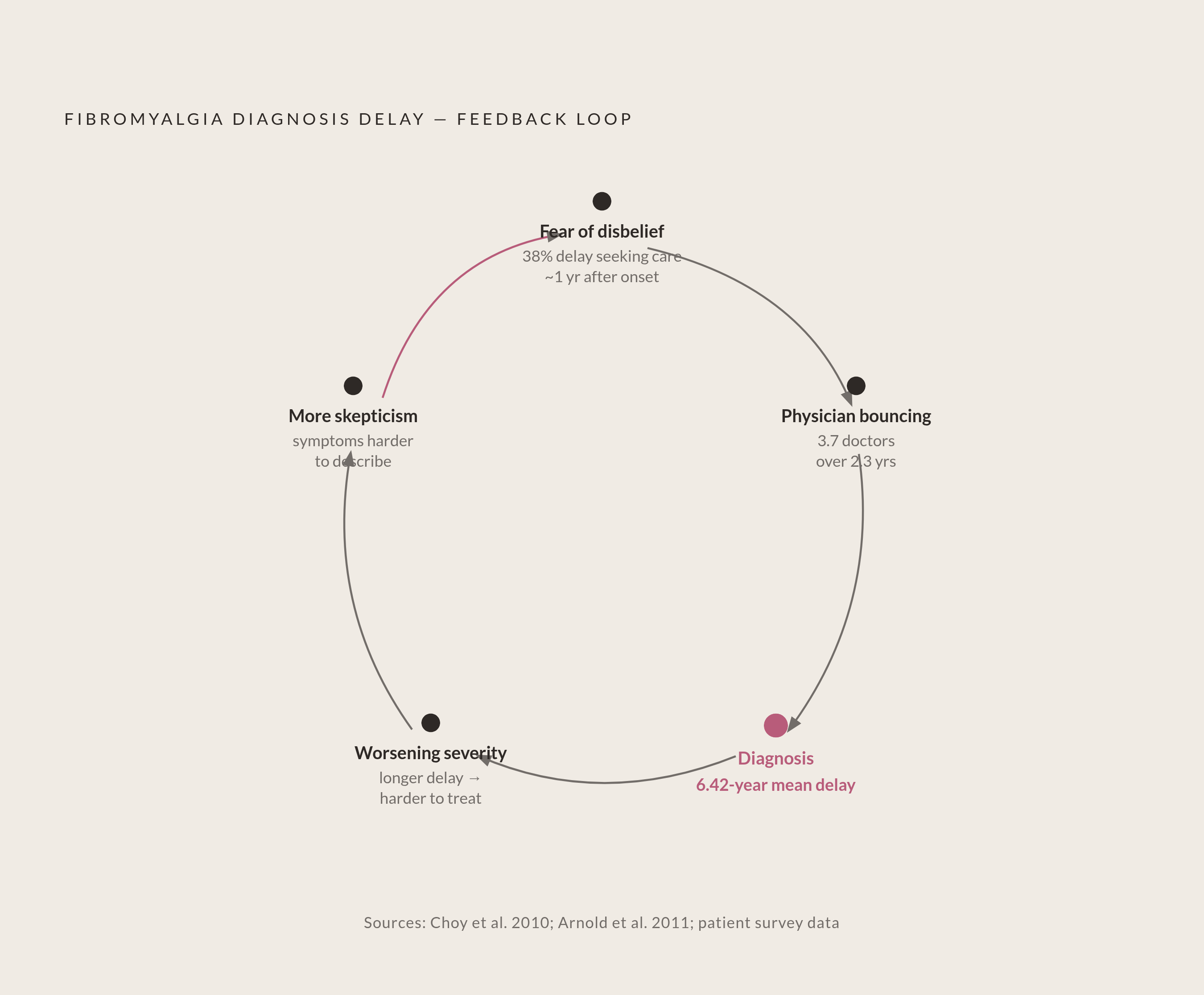
The delay starts before the first appointment. In a multi-country patient survey, 38% of people with fibromyalgia said they put off seeing a doctor at all, simply because they expected not to be believed. Once they did go in, patients had already waited close to a year on average after symptoms started before seeking care.
That's just the front end. After presenting, it took an average of 2.3 years and visits to 3.7 different physicians before landing on a diagnosis. Add it up, and one large Israeli cohort study covering thousands of patients found a mean total time from symptom onset to diagnosis of 6.42 years, while a separate 2023 analysis by Moshrif and colleagues put the figure at 5.6 years. Different studies, telling the same story.
This isn't only frustration or wasted time. Research has found that longer time to diagnosis is associated with poorer patient outcomes, including worsening disease severity. The delay itself becomes part of the disease course, a factor that shapes how the illness unfolds well before real treatment starts.
Here's the trap, plainly: fear of not being believed delays the first visit, and the delay lets symptoms worsen. Worse symptoms are harder to describe clearly and consistently, which makes the next doctor even more likely to doubt the account, and the cycle feeds itself from there. Breaking it means changing the one variable a patient actually controls: how they show up to the appointment, regardless of whether the disease has biomarkers. That's the whole argument of this piece, stated once, up front.
What "medical gaslighting" looks like in a fibromyalgia appointment
Strip away the jargon and medical gaslighting just means this: a patient describes their own body, and the response is disbelief. It goes beyond a diagnosis of exclusion or a cautious "let's keep looking" — it's active doubt that the experience is real at all.
For fibromyalgia patients, that shows up in a handful of recognizable ways. Symptoms get pinned on anxiety, stress, or a supposed need for attention, and referrals bounce from rheumatology to neurology to psychiatry with nobody agreeing to manage the case. Normal test results get treated as though they settle the matter, when a normal scan says nothing about pain the scan was never built to detect in the first place. Research from 2025 pulled directly from online patient forums found people describing rheumatologists and pain specialists who simply don't recognize fibromyalgia as legitimate, and who check out of the conversation the moment it comes up.
The emotional cost compounds from there. When a doctor denies the diagnosis is real, patients tend to internalize that doubt, and the same 2025 research links this internalizing to worse social isolation and loneliness down the line. None of this is about blaming one clinician for having a bad day or thin training. It's about naming the pattern ahead of time, so a patient walks in prepared instead of blindsided.
The strategies below work because they target the actual reasons dismissal happens: not enough objective information on the table, too little time in the appointment, and real uncertainty among physicians about who's supposed to own the case.
What should a fibromyalgia patient document and bring to appointments when there are no test results to show?
"I'm in pain all the time" is easy for a rushed doctor to wave off, while six weeks of dated, specific entries showing exactly when pain spikes and what changes around it is much harder to dismiss out of hand. Specificity is what shifts the conversation, not volume of complaint.
A useful log tracks a handful of things, consistently:
- Pain level on a 0-10 scale, plus location, duration, and quality (burning, stabbing, aching)
- Triggers that came before a flare: activity, sleep, stress, weather, food
- What eased it and what made it worse
- Functional impact: sleep lost, work missed, movement limited, cognitive fog episodes
Frequency matters more than most people expect. Daily or weekly entries show a trend, while a single account pieced together from memory at the appointment tends to reflect recency bias, whatever felt worst in the last 48 hours. The goal isn't a giant catalog of every twinge, but a clear pattern of what shifts and what stays put over time.
A few tools exist built for exactly this. Human Health lets patients log symptoms and tracks change across days, weeks, and months, then generates a report to bring into an appointment. Another option focuses on pulling together medical records from multiple providers into one place, which matters for patients who've already seen 3 or 4 different specialists over the years and have records scattered across that many systems. More broadly, an AI health companion built around chronic illness can take voice or text entries over time and surface patterns a patient might miss on their own, filling the gap between visits without asking the patient to play doctor.
None of this requires an app, since a plain notebook with consistent daily entries builds the same pattern record. The tool matters less than the consistency behind it.
Preparing the one-page summary that changes how appointments go
Appointment windows run short, often 15 minutes or less, and a doctor's read on a patient tends to form in the first two minutes of that window. Patients who walk in with organized information change that dynamic before they've said much of anything at all.
Some patient advocates call this a "Pain Portfolio," a single page that turns weeks of tracking into something a doctor can scan in under a minute. It should include:
- A top-line summary of the current pattern in 2 or 3 sentences
- Severity trend: worsening, stable, or improving over the tracking period
- Most disabling symptoms, ranked by functional impact rather than raw intensity
- What's already been tried, and what happened when it was
- The specific question or decision the patient needs help with today
Hand this over early in the visit, not at the end. A summary read at minute 2 shapes the whole conversation; one pulled out at minute 13 gets skimmed at best, on the way out the door.
An AI health companion that turns logged entries into a doctor-ready summary takes this task off the patient's plate entirely, and that matters more than it sounds like it should. Cognitive fatigue is itself a fibromyalgia symptom, so asking a flaring patient to build a clean summary from scratch the night before an appointment is asking a lot of someone already running on empty. Having the plan ready in advance also guards against a pattern that shows up again and again: patients minimizing their own symptoms in real time, especially after they've been dismissed before.
How to say it in the room without being dismissed again
Lead with function, not feeling. "This has kept me under four hours of sleep on four nights this week" lands harder than "I'm really tired," because it gives the doctor something concrete to respond to instead of something to interpret on the fly.
A few specific language moves help:
- Anchor to a pain scale the doctor already uses: "At its worst last week it hit an 8; my baseline runs around a 5."
- Name the pattern, not the moment: "This flares consistently 24 to 48 hours after any sustained activity."
- Pick one or two priorities per visit instead of reading off every symptom at once. Bundling everything into one list guarantees most of it gets lost.
- Skip the apology. "I know this sounds vague, but..." undercuts the account before the doctor has even heard it.
Tone matters as much as content here. Calm, specific, and persistent reads as credible, while visible distress, though completely legitimate, hands a rushed clinician an easy exit: redirect the conversation toward emotional support instead of physical treatment, and the appointment is over without anything actually decided.
Ask questions that require a real clinical answer, not a brush-off:
- "What would you expect to see change if this treatment is working?"
- "What's your thinking on why this pattern shifts with activity level?"
- "If this isn't something you manage, who would you send me to?"
Asking questions and stating preferences is widely recommended in patient advocacy guidance as a way to improve how care plays out, not just a soft self-help tip. Bringing a trusted person into the room (a partner, a friend, a parent) also shifts the dynamic and adds a second set of ears, and research on chronic pain self-advocacy backs this as a practical tool for handling the appointment well, not a sign of weakness.
When to escalate, switch providers, or seek a specialist
Not every dismissive relationship is fixable from the inside, and staying in one out of loyalty or exhaustion costs real time. Part of self-advocacy is recognizing when to walk and find someone else.
A few signs the current relationship isn't working:
- Repeated denial that fibromyalgia is even a valid diagnosis, despite documented evidence in hand
- Refusal to engage with a structured symptom summary once it's handed over
- Symptoms consistently pinned on psychological causes with no physical follow-through at all
- No referral offered, even after the provider has said outright this isn't their area
From there, the path forward has a few concrete options, and a second opinion should be the default move, not the last resort. Frame the request to the current provider as seeking added expertise rather than a vote of no confidence. Push for a referral to a rheumatologist, neurologist, or pain specialist with actual documented experience managing fibromyalgia specifically, not just general familiarity with chronic pain. Organizations like the Fibromyalgia Fund and the American Fibromyalgia Syndrome Association (AFSA) keep patient resources that help track down providers who list fibromyalgia explicitly among the conditions they treat. The U.S. Pain Foundation also offers guidance and case management support for patients navigating a system this fragmented.
Keep every record portable, no exceptions. A complete, organized symptom history and medication list means a patient doesn't start from zero with a new doctor, and that's exactly where a single digital health record pays off over years, not months. Because no specialty clearly owns fibromyalgia, patients often end up working through several referrals before finding the right fit. The documented record is what holds continuity together across that whole process, when nothing else does.
The psychological weight of not being believed, and why it is not the patient's fault
The numbers here are hard to look past. A 2025 meta-analysis spanning 62 studies and 21,591 patients, alongside a second covering 88 studies and 31,104 patients, found that 46.6% of fibromyalgia patients experienced clinically significant anxiety, and 50.8% had depression. Both rates point to a substantial psychological burden accompanying the condition.
Research has found that fibromyalgia patients show higher rates of self-criticism and a reduced capacity to reassure themselves, compared with people without the condition. Self-criticism doesn't just show up as a reaction to distress; that pattern can deepen distress over time, which makes it a mechanism worth naming, not just a symptom to note in passing.
Here's that mechanism plainly: dismissal from a doctor doesn't just leave a patient without treatment, it reinforces doubt about their own experience of their own body. That doubt makes the next appointment harder to walk into, the next summary less confident to hand over, the next conversation more hedged and apologetic. Minimizing symptoms, second-guessing them, apologizing for bringing them up at all: this is a predictable response to being doubted over and over, worth treating as exactly that rather than as a personality trait to fix.
The same PLoS ONE research found that psychological interventions work best for fibromyalgia patients when they directly target self-criticism and build the capacity for self-reassurance, rather than focusing only on coping with pain itself. Practically, that means a symptom log and a prepared summary aren't just clinical paperwork; they're external proof a patient can hold onto when internal confidence starts to slip. And for patients whose anxiety or depression is genuinely interfering with daily life, bringing a mental health professional into the care team alongside the physical side is worth raising directly with a general practitioner, as part of the same fibromyalgia management plan rather than a separate track.
Making the space between appointments work for you
Most of managing fibromyalgia happens far from any clinic. The appointment itself is a narrow window, maybe 15 or 20 minutes every few months, and everything a patient brings into that window gets built in the weeks before it.
Tracking only works if it's low-friction. If logging a symptom takes real effort, it stops happening on the worst days, and the worst days are exactly the ones that matter most for the record. The period between visits should produce a few concrete things: an updated read on whether the pattern has shifted since last time, a record of whether whatever got agreed on last visit actually got tried, and a short, specific list of what the patient wants out of the next appointment.
AI health companions built specifically around chronic illness, grounded in how these conditions actually behave rather than general wellness tracking, can hold this together between visits. Logging by voice or text, tracking sleep and activity and symptoms side by side, building the summary a patient hands over next time: that's the narrow, specific function these tools serve alongside the doctor's care.
Research on electronic patient-reported outcome tools backs this up directly. When patients and providers track progress together between visits using linked tools, goal-oriented care gets measurably better. The between-appointment record isn't a nice extra, but the structure the whole relationship stands on, and without it, every appointment starts back at zero.