Fibromyalgia Flare Triggers and How to Identify Them
Flares lag 24-48 hours behind their actual trigger, making them seem random without proper tracking.
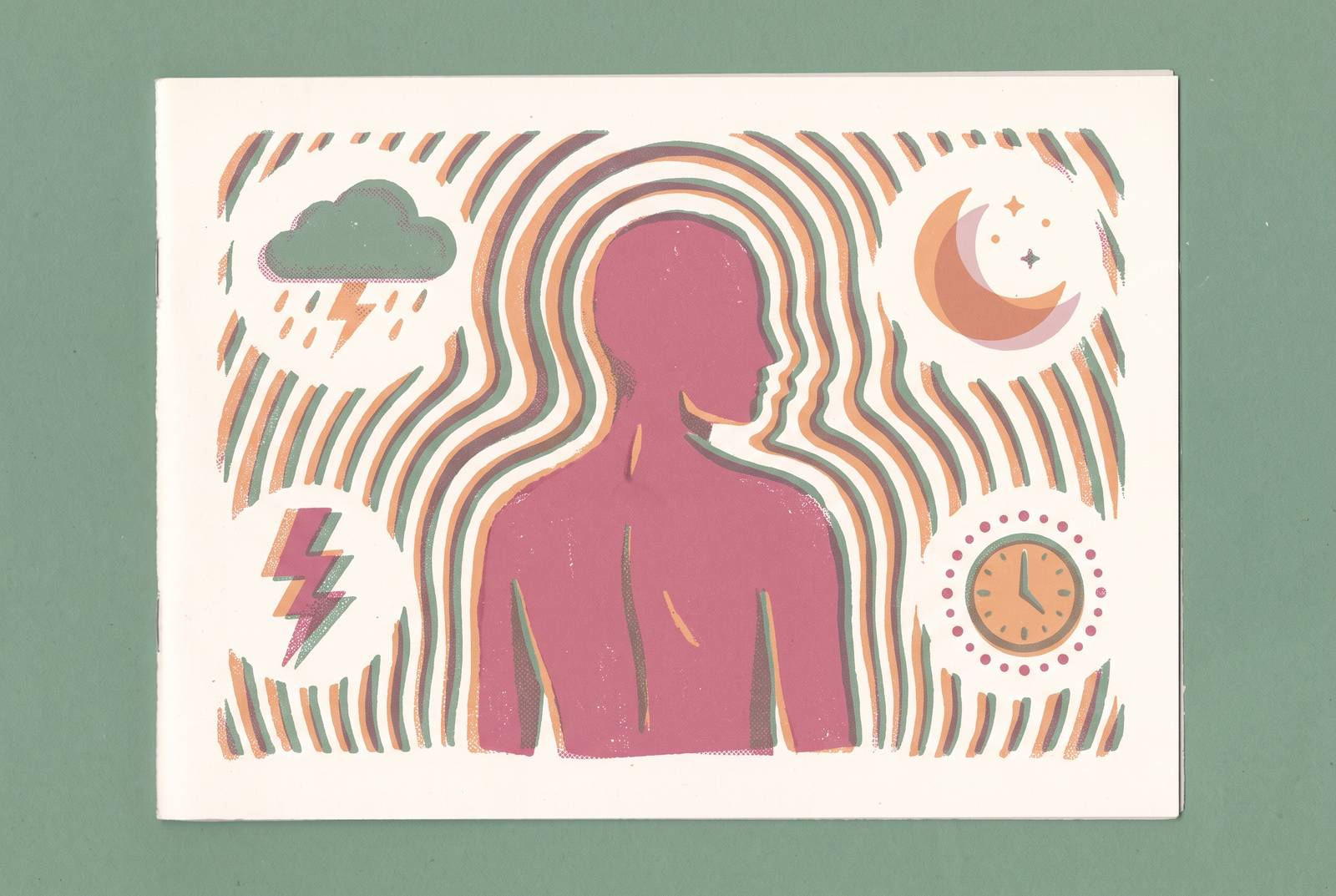
Fibromyalgia flares don't send a warning. Pain, fatigue, and brain fog spike, sometimes overnight, and the person living through it starts scanning the last 48 hours for a cause that rarely announces itself. Here's what the research actually shows: fibromyalgia triggers are personal, and the flare almost never happens on the same calendar day as whatever caused it. Most people track the wrong thing, at the wrong time, for too short a window, then conclude their flares are random. In reality, they're delayed and compounded, and the only way to see that is a log built to catch both.
Fibromyalgia's central sensitization means the nervous system is already running at an elevated baseline, so a trigger doesn't need to be dramatic to push it over the edge. The flare typically surfaces 24 to 48 hours after the causative event because the body's physiological response builds gradually rather than switching on immediately. Sleep sits at the center of that delay in a specific way: restorative sleep is when the body clears the inflammatory cytokines accumulated during the day, and when that overnight clearance doesn't complete, the pain-amplification system starts the next morning already primed and with less capacity to absorb whatever comes next. One disrupted night doesn't just produce tiredness; it narrows the buffer, so a stressor that would have been manageable instead tips into a flare that appears, to anyone looking only at the day it arrived, to have come from nowhere.
Why does a fibromyalgia flare often show up days after the trigger, and what does sleep have to do with the delay?
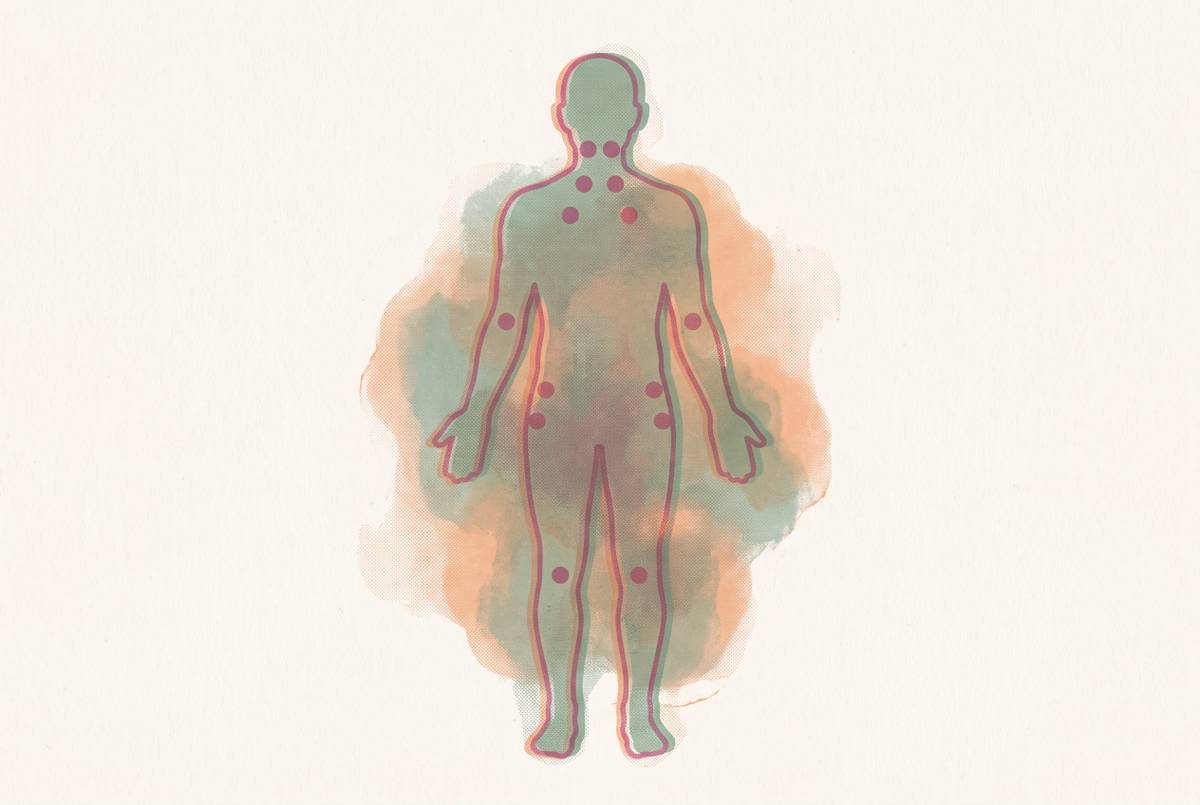
Fibromyalgia runs on central sensitization: a nervous system that's turned its own volume knob up, so signals that should register as mild pressure or ordinary muscle fatigue get processed as pain. During a flare, that amplification gets worse. A car horn, a cold draft, a long meeting, all come through louder than they should.
Underneath that sits a stress-response system already running hot. The HPA axis and the sympathetic nervous system sit closer to threshold in fibromyalgia than in people without it, so a stressor most people shrug off can push the body into an outsized physiological response.
Sleep makes this worse in a specific, mechanical way. Restorative sleep is when the body clears inflammatory cytokines built up over the day. In fibromyalgia, that overnight clearance often doesn't finish, so the sensitization system starts the next day already primed. One bad night doesn't just cause tiredness; it hands the pain-amplification system less room to absorb whatever comes next.
There's newer evidence pointing at the gut, too. A 2025 study found that transplanting gut bacteria from fibromyalgia patients into germ-free mice induced pain behavior and immune activation patterns that mirror the human condition. That should be treated as a lead rather than a conclusion — mouse pain behavior is a proxy, not a direct read on human flares. Still, it's a plausible mechanism worth watching, and it fits the broader pattern: gut health likely shapes how vulnerable someone is to a flare on any given day, even if the exact contribution isn't pinned down yet.
Put it together and the real mechanism comes into focus: the system doesn't need one big trigger. It needs a small one landing on a nervous system that's already sensitized, and because the effects lag hours or days behind the actual event, the trigger and the flare rarely land on the same day. The math holds up; the input is just missing from where most people are looking.
The triggers that appear most often across the research
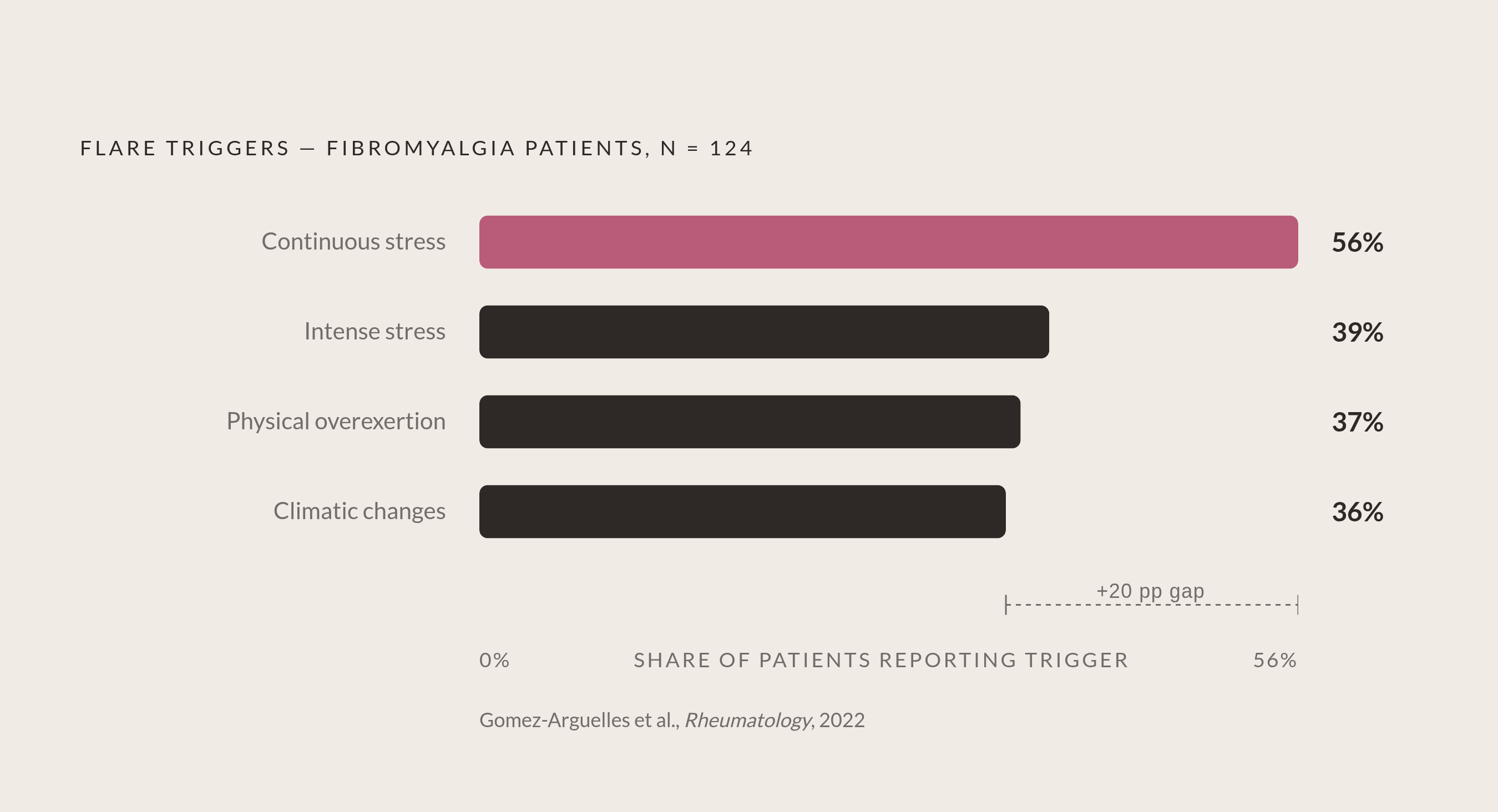
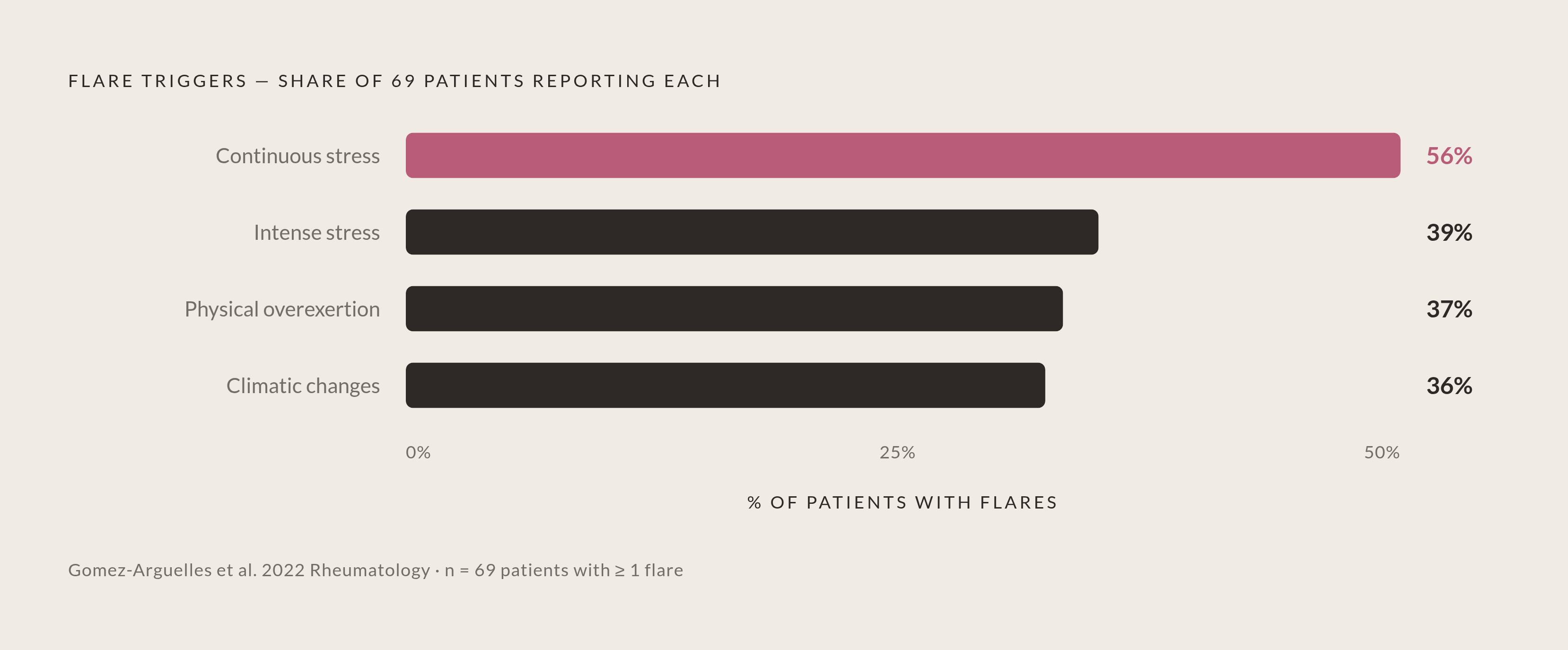
The most rigorous prospective data here comes from Gomez-Arguelles and colleagues, published in Rheumatology in 2022. Researchers followed 124 fibromyalgia patients for at least six months. Sixty-nine of them, 75%, reported at least one flare, averaging two flares each, with a mean flare duration of 11 weeks. That's nearly three months of disruption from a single episode.
Four triggers dominated what preceded those flares: continuous stress (56%), intense stress (39%), physical overexertion (37%), and climatic changes (36%). Worth sitting with the gap between those numbers for a second: continuous stress and climatic changes are 20 points apart, which tells you this isn't four equally weighted causes — it's one dominant driver and three secondary ones. Population-level signals, not individual guarantees, but a solid starting map.
Stress deserves top billing, and not by a small margin. A 2017 study by Hassett and colleagues in Pain, tracking 333 patients, found self-reported stress was the strongest predictor of next-day pain intensity, stronger than physical activity, sleep quality, or weather. That ordering is worth pausing on — weather is the one people fixate on ("it's going to rain, my joints know it"), yet in this dataset it ranked behind something far less visible. The dysregulated HPA axis turns emotional and physical stress into physical consequences out of proportion to the stressor itself.
Sleep disruption runs in both directions, which is what makes it dangerous. Pain disrupts sleep, disrupted sleep amplifies pain, and that loop can keep a flare going long after whatever started it has faded. Skip hours-in-bed as the metric. Track whether someone wakes up rested, how often they wake in the night, and how that quality tracks against next-day pain.
Weather shows up often enough to matter, particularly drops in barometric pressure and rises in humidity. Cold, damp conditions stiffen muscles, and sudden pressure or temperature shifts seem to knock the body's homeostasis off balance even when the swing itself is mild. Some patients feel this acutely; others barely notice it. That gap is the entire argument for tracking your own data instead of trusting a population list.
Physical overexertion and its opposite deserve equal weight, because misjudged pacing in either direction is the real culprit. Post-exertional symptom escalation can surface well after the activity itself, so without a log connecting today's crash to a hike or a heavy work sprint from days back, that link never gets made. Most people never make it.
Hormonal shifts, infections (including lingering post-COVID symptoms), certain foods, medication changes, and major life events round out the list. None of these show up as reliably as stress, sleep, weather, or exertion, but they still belong in the log.
One flag worth remembering: a flare running longer than 4 to 6 weeks, bringing on symptoms that weren't there before, or arriving with joint swelling or fever falls outside the garden-variety pattern. That combination is worth a call to a doctor. It can signal a co-occurring inflammatory condition that needs ruling out.
Why the same trigger affects people so differently
Fibromyalgia's prevalence numbers tell you how variable this condition is before you even get to triggers. Global estimates put it around 2.7%, but a 2024 analysis in the International Journal of Rheumatic Diseases found country-level rates ranging from 0.4% to 9.3%. That's more than a twentyfold spread, which doesn't happen with a condition driven by one clean mechanism or measured the same way everywhere — some of that range is almost certainly diagnostic variation, not just biology. Genetics, environment, and overlapping conditions all shape how it shows up, and that same variability plays out trigger by trigger, person by person.
Comorbidities load the dice further. IBS, osteoarthritis, lupus, rheumatoid arthritis: each adds its own layer of inflammation or sensitization, so someone managing fibromyalgia alongside one of these starts from a different baseline than someone who isn't. Hormonal cycles matter too. Women make up the large majority of diagnosed cases, and for many, fluctuations across the menstrual cycle are a real, repeatable trigger.
Here's what trips people up most: flares are rarely caused by one thing. They're caused by convergence. A stressful week, stacked on a bad night's sleep, stacked on a pressure drop, can produce a flare that none of those three would cause alone. Chasing a single smoking gun misses how this actually works, and it's the single most common mistake in how people try to manage this condition.
Trigger lists still have value as a starting hypothesis. They stop being useful the moment someone treats them as a diagnosis instead of a hunch to test. The only way to find actual thresholds, and actual combinations, is tracking personal data over time.
What consistent tracking actually looks like in practice
Start with structure the field already trusts. The American College of Rheumatology's Widespread Pain Index and Symptom Severity Scale are the validated clinical tools for self-reported fibromyalgia symptoms, and they're a solid anchor for a daily log even outside a clinical setting.
Worth tracking every day, at minimum:
- Pain intensity and location
- Sleep quality, specifically how rested someone feels on waking, not just hours slept
- Mood and stress level
- Physical exertion, cognitive load, weather or environmental shifts
- Food, alcohol, caffeine, hormonal cycle stage, and medication changes
Mood belongs on that list for a concrete reason. Explainable AI analysis of fibromyalgia datasets has found mental health factors more relevant to symptom severity than perceived pain factors. That's a counterintuitive result worth sitting with: it suggests the thing most logs treat as an afterthought might actually be carrying more predictive weight than the thing the log is built around. Tracking pain alone means missing one of the strongest signals in the whole dataset.
Patterns don't show up fast, and expecting them to is where most logs get abandoned. Give it four to eight weeks of consistent logging before expecting anything legible. A single bad day tells you almost nothing on its own; the pattern across weeks is what separates a real trigger from a coincidence.
The delayed-trigger problem is the single biggest reason people miss their own triggers. If a flare shows up 24 to 48 hours after the activity that caused it, a log that only captures "how do you feel right now" leaves that connection invisible. The log has to tie today's pain back to yesterday's context and the day before's, every single time, or it's not doing its job.
Timing of entries matters, too. Memory of pain intensity fades fast, and end-of-day recall is a weaker signal than logging close to the moment something happens. Wearables, sleep stage data, heart rate variability, step counts, add objective texture where memory and self-report fall short, especially sitting next to symptom notes instead of floating on a separate dashboard nobody checks.
Pacing as the active companion to trigger tracking
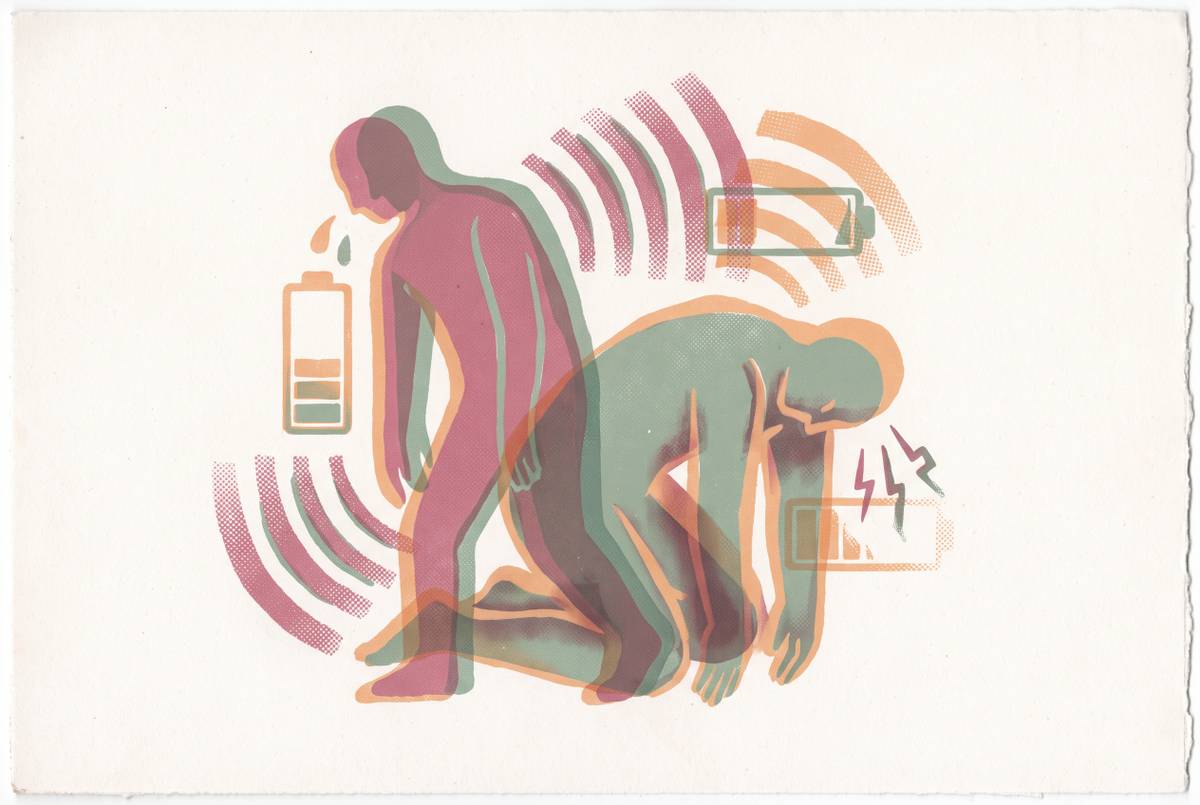
Spoon Theory is still the clearest shorthand for this. Each day starts with a fixed number of spoons, units of energy, and every task, physical, cognitive, emotional, costs one. Unlike someone without fibromyalgia, that supply doesn't refill easily once it's spent.
The boom-and-bust cycle is the most common failure mode, and it's worth naming directly: a good day shows up, someone pushes through errands, work, and social plans they'd been postponing, and the crash lands the next day, sometimes worse than the flare that made them cautious in the first place. Understandable trap. Also one of the most reliable ways to extend a flare instead of recovering from it.
Pacing without a log behind it is mostly guesswork. Once someone knows their thresholds and combinations from tracking, spoons get budgeted ahead of time instead of rationed in a panic after the crash starts. Spoon theory functions as a self-pacing strategy built around working to a quota, treating it as a practical tool grounded in the patient community's own framework.
A few pacing principles worth building around:
- Spread demanding tasks across the week instead of stacking them into one day
- Build recovery time in before and after anything high-cost, not just after
- Count cognitive and social demands as spoon costs, the same as physical ones
- On a good day, resist the pull to catch up; protect tomorrow's baseline instead
The log is what makes any of this possible. It shows which activities cost more than they feel like they cost in the moment, and that gap between felt effort and actual cost is exactly what pacing without data can't catch.
Turning a symptom log into something a doctor can actually use
Fibromyalgia is an invisible illness, and most appointments ask patients to summarize months of fluctuating symptoms from memory in fifteen minutes. Hard task even with a sharp memory. For someone managing pain and cognitive symptoms at once, it's close to unworkable, and that gap is exactly where a structured log earns its keep.
A log fixes what memory can't reach. It shows flare frequency and duration over time, surfaces the trigger patterns that repeat, and documents what's actually helped versus what hasn't. Given that mean flare duration runs around 11 weeks, a patient may well be mid-flare at nearly any appointment they attend. A log showing the trajectory gives a doctor something memory alone never could.
Keep the format short. A one-page summary covering the past four to eight weeks, the top suspected triggers, average pain and sleep scores, and any new or worsening symptoms is something a doctor can actually read and act on inside a ten-minute visit. A notebook full of scattered daily entries is harder to use in the same window.
A handful of AI-assisted health tools built for chronic illness tracking now do a version of this work directly: logging symptoms by text or voice, surfacing patterns across sleep, activity, medication, and context, generating a doctor-ready summary from that data. Whether that pattern-surfacing holds up as well as a few months of deliberate, self-kept logging remains an open question — automated correlation-spotting is only as good as the context it's given, and context is exactly what's hardest to capture automatically. What these tools reliably do is cut the burden of preparation, so someone walks in with organized, legible information instead of months of scattered memory.
The upside runs both directions. A good log doesn't just help a doctor make better decisions; it helps the patient recognize when something has crossed a line worth acting on: a flare stretching past six weeks, a new symptom, joint swelling, fever. Those are the moments tracking exists for, catching the pattern early enough to act on it instead of just explaining a bad week after the fact.