How to Appeal a Fibromyalgia Benefit Claim Rejection in the UK
Appeal a rejected fibromyalgia claim by proving how symptoms limit your daily activities reliably.
To appeal a rejected fibromyalgia benefit claim in the UK, you need to show what your symptoms stop you doing reliably as well as prove your diagnosis. This guide focuses on PIP, where an assessment can miss the effects of a variable, invisible condition. A refusal is contestable, and evidence tied to daily activities gives an appeal its strongest foundation.
Why fibromyalgia claims fail at the first decision and what that means for an appeal
The DWP assesses ten daily living activities and two mobility activities, but the limits fibromyalgia puts on what you can do are hard to pin down and can change. Pain, fatigue and cognitive problems can affect several activities at once and can be worse on some days than others. An assessor who focuses on how you appeared at an appointment can miss how you function across a week.
Coping can also disguise the very difficulties the assessment should measure. Pacing, using aids and avoiding tasks may look like signs that you can cope, even when they are ways to manage how little you can do. Fibromyalgia has no single clinical marker that settles the question, so a letter that gives the diagnosis alone makes it harder to challenge a view based on only part of the picture. The appeal therefore needs to show how the help, rest or adaptations you needed differ from what a brief glimpse of you coping might suggest. That mismatch makes refusal predictable, but it also gives you something specific to contest.
What the PIP reliability test actually measures and where fibromyalgia scores points
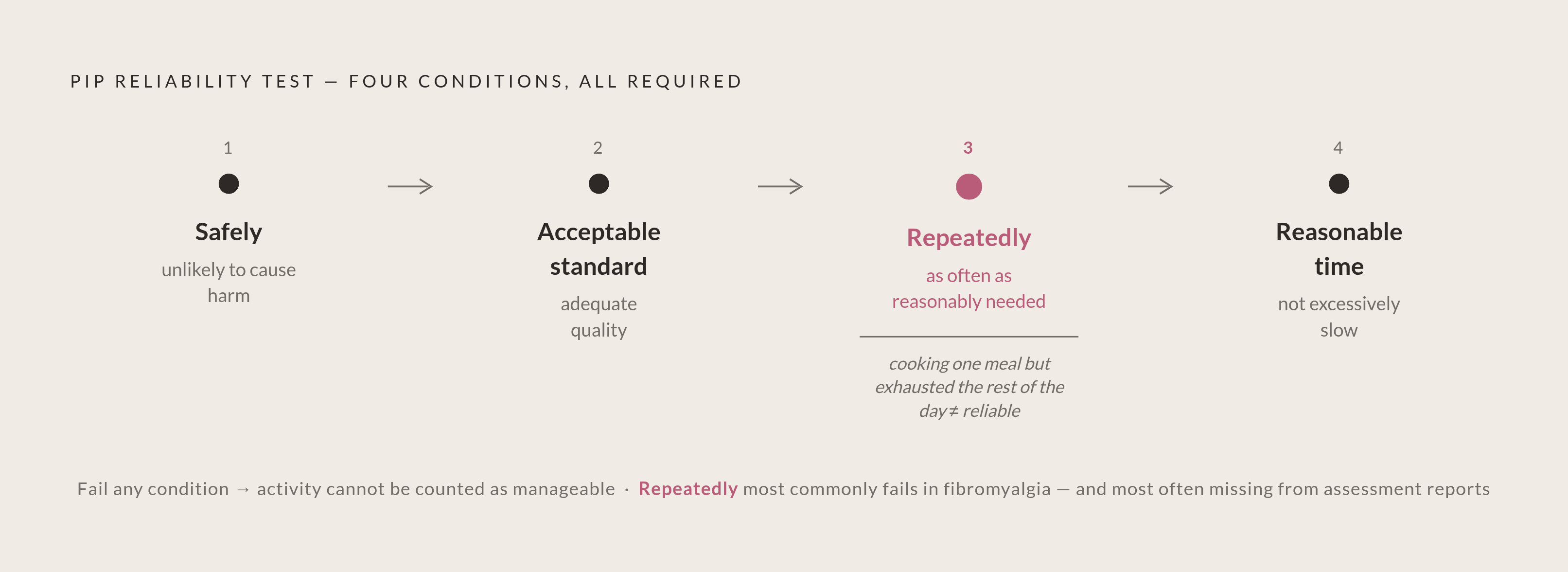
The Social Security (Personal Independence Payment) Regulations 2013 require assessors to check whether activities can be done safely, to an acceptable standard, repeatedly and within a reasonable time. Safely means unlikely to cause harm during or after the activity. Repeatedly means as often as it is reasonable to need to do the activity. Cooking one meal but being exhausted for the rest of the day is therefore not the same as being able to prepare food reliably.
Regulation 7 addresses fluctuation through the majority-of-the-time rule. A descriptor, which is the scoring statement for an activity, applies where the relevant difficulty affects you on more than 50% of days. Bad days do not have to be every day. For moving around, assessment considers whether you can walk the relevant distance reliably, including the lengthy recovery you may need after managing it once. Distance bands determine the points awarded.
Daily living examples show how to translate symptoms into the test. Pain while standing or gripping, fatigue partway through cooking and fibro fog around the cooker can affect preparing food. Pain raising your arms, difficulty getting into the bath and needing rest after a shower can affect washing and bathing. Stiffness in the morning and the need for breaks between steps can make dressing hard, while problems with memory may mean you need prompting to take medication. Cognitive effects can also affect budgeting, and pain, fatigue and unpredictable symptoms can affect engaging with others.
The assessment covers more than these examples, and having a symptom on its own does not earn points. The applicable descriptor matches the difficulty and support you need. Each component requires 8 points for the standard rate or 12 for the enhanced rate. Understanding where the reliability test should have affected your score gives you the first thing to check against the refusal letter.
How to read a refusal decision letter and identify what went wrong
Request the full assessment report, which is separate from the decision letter. It contains the assessor’s observations activity by activity and lets you see how the decision was reached. Read it line by line against your memory of the assessment and your actual daily function. If cognitive fatigue makes that difficult, ask someone you trust to help. The aim is to turn the refusal into a working document with identifiable errors.
Start with the descriptor chosen for each activity and check whether the report looked at reliability as well as whether you could do it at all. For example, “walked from waiting room unaided” leaves out important information if you walked slowly and needed to rest on arrival. Check whether a grab rail or shower seat was recognised as an aid. Then check whether the report addressed fluctuation or simply treated your presentation that day as typical.
Check whether memory problems and poor concentration were recorded, and whether any depression or anxiety was considered in its own right. Write down where the report got facts wrong, including a wrong walking distance or a score for an activity that was never discussed. Those corrections give the appeal a firmer basis than a general statement that the assessment was unfair.
How mandatory reconsideration works and what it realistically achieves
Mandatory reconsideration is the stage you must go through before a tribunal appeal. Ask the DWP for it within one month of the decision letter. The department then reviews its own decision. Overturning a refusal at this stage is uncommon, so treat it as a chance to put your challenge and evidence on the formal record. An unsuccessful reconsideration is not confirmation that your claim lacks merit.
In your written submission, set out each activity where you think the score is wrong, explain which descriptor you think applies and refer clearly to reliability. Respond to the reasons the DWP gave. Add new evidence of your daily difficulties, including medical letters, a diary covering several weeks and a dated statement from someone who sees those difficulties. Evidence submitted now will be before the tribunal if the case goes further.
This stage deserves care, but it should not consume all the energy available for the appeal. Its practical value is that it sets out the dispute and builds the evidence for independent consideration. If the decision remains unchanged, the DWP issues a mandatory reconsideration notice, the document needed to proceed to tribunal.
How the First-tier Tribunal works and why it produces very different results
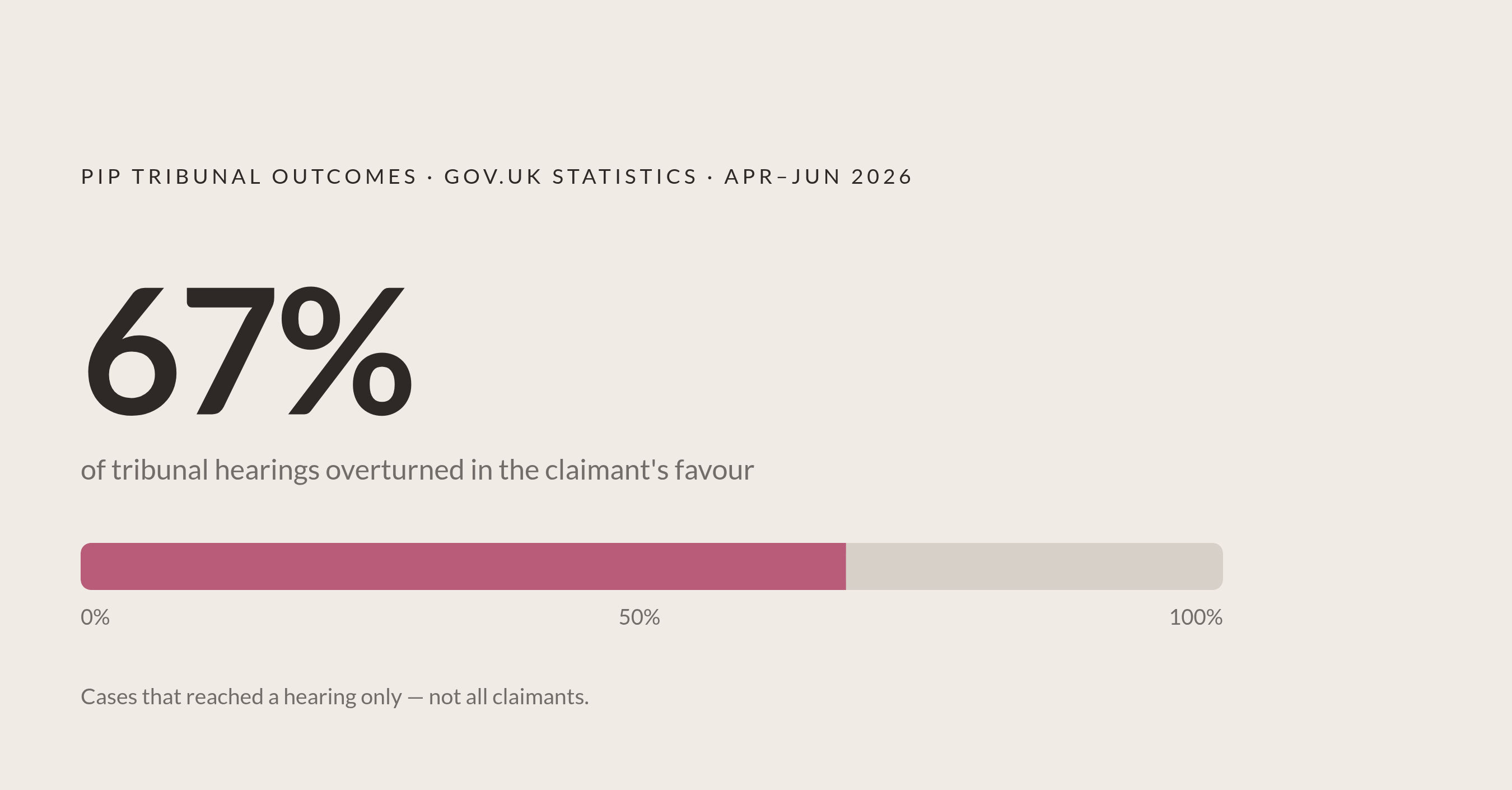
GOV.UK Tribunal Statistics Quarterly April to June 2026 reports that 67% of PIP decisions cleared at a tribunal hearing were overturned in favour of the claimant. That figure concerns only cases reaching a hearing and cannot guarantee an individual result. To make your own case, the task is to show precisely where the decision failed to reflect the PIP rules and your daily function.
The First-tier Tribunal is independent of the DWP. The panel usually has a legally qualified judge, a medical member and a disability-qualified member. The tribunal applies the reliability test, the majority-of-the-time rule and the full descriptor schedule, and it can hear evidence directly from you. That gives it a different basis for understanding variability than a paper-based reconsideration.
Support can help you prepare that evidence and explain it. Citizens Advice, local welfare rights services, Scope, Turn2us, Versus Arthritis and Fibromyalgia Action UK publish guidance, and some offer direct casework support. Ask whether free representation is available, as some organisations may be unable to offer it. The next step is to assemble evidence that makes your limitations clear without relying on the panel to infer them from the diagnosis.
Building an evidence bundle that works for a variable, invisible condition
Start with medical evidence that describes function. A rheumatologist’s letter can be the strongest single document, but it needs to go beyond confirming fibromyalgia and explain how symptoms affect the activities in question. Ask your GP for the same focus, with reference to PIP descriptor categories where possible. Ask for copies of pain clinic notes, occupational therapist assessments and physiotherapy records that describe how you function. A full list of prescribed medicines, over-the-counter products and supplements also shows the treatment burden and supports evidence about managing medication.
Next, use a diary to make fluctuation visible. The Royal College of Physicians’ UK clinical guidelines on fibromyalgia suggest that symptom diaries may help with assessment because cognitive symptoms and the stress of an appointment can make it hard for patients to explain things. For an appeal, several weeks of entries give a clearer account than a short snapshot. Record good days as well as bad ones, so the diary shows the contrast and the recovery between them. A bad-day-only account is easier to dismiss as selective.
Each entry should capture pain level and location, fatigue, sleep quality, tasks attempted, whether they were completed, time taken, recovery needed and any aids or help used. The important detail is not just that a task hurt, but what happened to your ability to finish it or do something afterwards. Structured text or voice logging can help turn fragmented entries into a readable summary. Where a tool links sleep, activity and medication information, that summary can make patterns easier to follow.
Then add evidence from people who regularly see what daily life involves. A carer, partner or family member should describe specific help, such as opening jars, carrying pans or supporting you after showering. Their statement should be written and dated. Care workers, social workers and community nurses can add what they see through their work.
Keep corrections to the assessment report in a written rebuttal separate from your personal statement. Quote the disputed wording and correct it line by line, showing where an observation was wrong or incomplete. Across the bundle, every document should serve the same purpose. It should help the panel decide whether, on more than half of days, you can perform the relevant activity safely, to an acceptable standard, repeatedly and within a reasonable time. The diagnosis explains the condition, but functional evidence makes the appeal.
Using energy management principles to prepare for and recover from the tribunal itself
Getting ready for a hearing and going to it can use much of the limited energy your condition leaves you with. Christine Miserandino’s Spoon Theory offers a way to describe that limited energy, which changes from day to day. In this context, the main risk is the boom-bust cycle. Travel, sitting through the hearing and coping with the demands it puts on your thinking and feelings can use several days’ worth of energy at once. Planning around that cost is part of presenting the case.
Plan a lighter day before the hearing and a day to recover afterwards, cutting back on other things that take a lot out of you where possible. If travel is difficult, ask the tribunal to consider a paper hearing or a telephone or video option. A short GP statement about the impact of travel can support that request. Bring a representative, friend or carer for practical support and to help the panel understand the support you need.
During the hearing, you do not need to hide pain, difficulty finding words, prompting needs or the need to shift position. Those difficulties are consistent with the evidence you are asking the panel to consider. Energy tracking during preparation can also strengthen the diary if it records an increase in symptoms caused by that work.
The policy context in 2026 and what it means for claimants appealing now
The proposed “4-point rule” is no longer part of the legislation. Clause 5 of the Universal Credit and Personal Independence Payment Bill was removed on 1 July 2025 after a Labour backbench rebellion and dropped permanently at the bill’s third reading on 9 July 2025. If you delayed applying or withdrew a claim because you expected that rule to take effect, that reason for holding back has gone. There may be grounds to re-engage with the claims process.
The Timms Review interim report, published on 9 July 2026, concluded that PIP is no longer fit for purpose and is failing to keep pace with changes in disability, health and work over the past decade. The government-commissioned review is led by Minister Sir Stephen Timms, with its final report due in Autumn 2026. Its findings will inform future eligibility changes, but the review does not change the rules used to assess claimants today. The current legal framework remains in place.
Future rules are uncertain, and any transitional protections for existing awards will depend on what Parliament legislates. An unpursued appeal offers no such protection. That uncertainty is a reason to take the current opportunity to challenge a refusal seriously.