Fibromyalgia Tender Points vs Widespread Pain Criteria
How doctors learned to diagnose fibromyalgia without a test.
Fibromyalgia has no blood test, no scan, no biopsy that lights up and says "here it is." What changed between 1990 and today isn't the disease itself, it's how doctors learned to recognize it, and that shift matters enormously for anyone trying to get diagnosed and taken seriously. The 1990 criteria got the mechanism wrong and missed most patients who actually had the disease. The 2016 revision, whatever its remaining flaws, is the version worth understanding, because it's the one that finally treats patients as a reliable source of their own data.
Fibromyalgia is a chronic centralized pain syndrome. The nervous system's general processing of pain signals, rather than damaged tissue somewhere in the body, drives the problem. The mechanism is called central sensitization: the nervous system amplifies pain signals that shouldn't hurt as much as they do, and it does so inconsistently across the body, which is why the pain moves around and varies day to day. Around that pain sits a cluster of other symptoms: fatigue, sleep that doesn't refresh, cognitive slips patients call "fibro fog," and mood disturbances that come bundled in more often than not.
Diagnosis has always come down to clinical judgment, a doctor listening to a patient's history and deciding whether the pattern fits. That absence of a test is the root of nearly every controversy that follows. Hearing "nothing shows up on your bloodwork" or "your scans are clean" is often the first invalidating moment on a long road toward being believed, and the diagnostic criteria have spent 35 years trying to fix that problem without a lab marker to lean on.
The 1990 tender point exam: what it was, why it was created, and what it missed
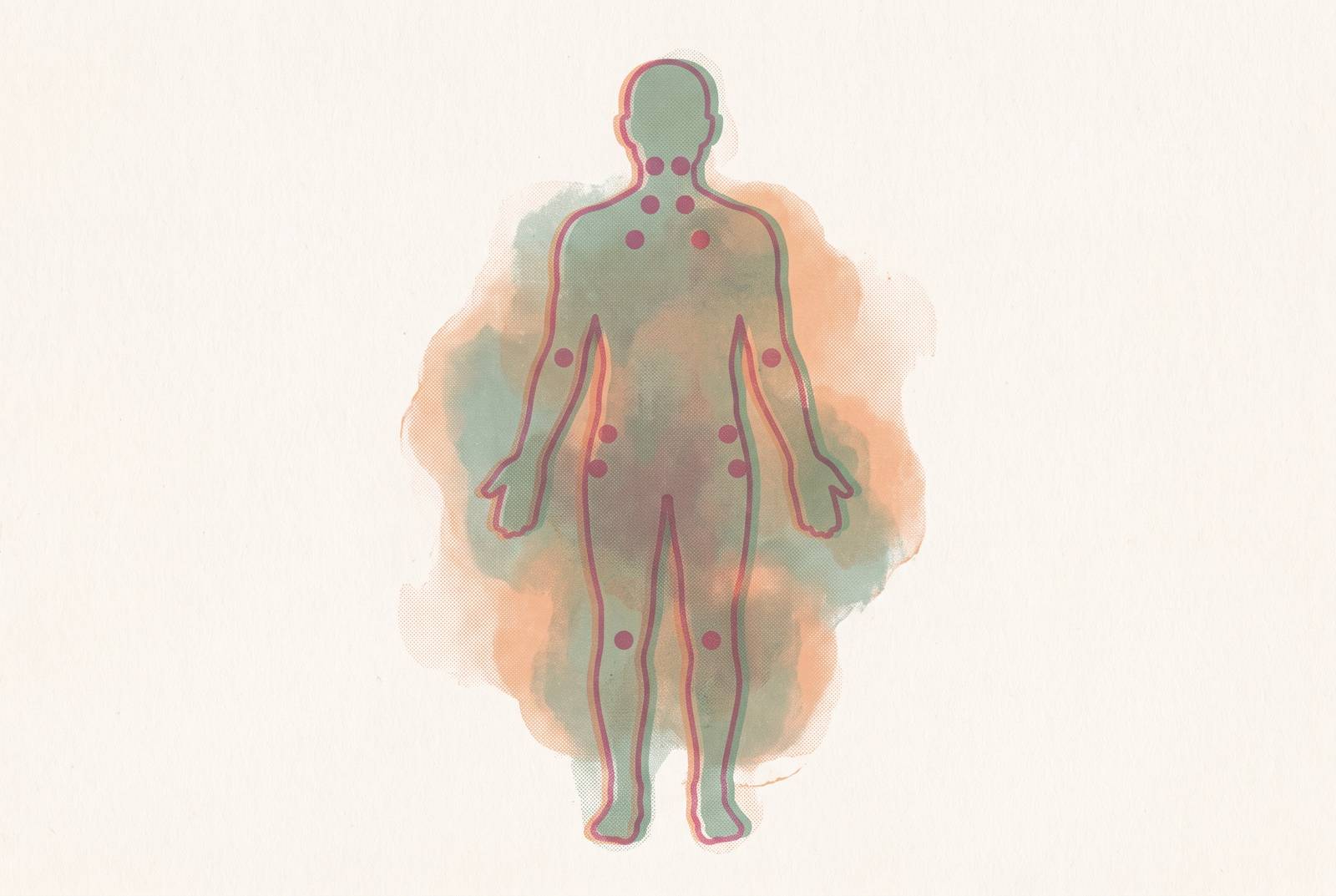
A leading medical association published its first fibromyalgia criteria in February 1990 in Arthritis & Rheumatism. The rule was mechanical: a patient needed at least 11 of 18 specific tender points to be painful under palpation, plus pain lasting more than three months, present on both sides of the body, above and below the waist, and in the axial skeleton. Examiners pressed on 18 anatomically defined spots and counted how many hurt. Fatigue, sleep problems, and cognitive issues weren't in the criteria at all.
The appeal is easy to understand in hindsight. In a condition with zero lab markers, the tender point exam gave doctors something to do with their hands, a physical test that felt objective even though it wasn't.
It was the wrong tool for the job, and the cracks showed early. Pressure was standardized loosely at around 4 kilograms of force but applied differently exam to exam, doctor to doctor. Tender points also fluctuate: a patient might register 11 painful points on a bad day and fall well short of that threshold a week later, so the same person could pass or fail the same test depending on when they walked in. About 25% of patients with a confirmed fibromyalgia diagnosis didn't actually meet the 11-point cutoff. Worse, the 11-of-18 threshold identified only about 20% of patients with widespread pain, meaning most people living with the condition were missed by their own diagnostic criteria.
Women test as more sensitive to tender point pressure than men on average, so the exam systematically over-diagnosed women while under-diagnosing men. That baked a gender skew into the data that had nothing to do with who actually had the disease, and the field is still climbing out of that hole today.
The exam was supposed to capture hyperalgesia, the heightened pain sensitivity central to fibromyalgia. Instead, it was heavily swayed by a patient's psychological distress in the moment. Too loose for some patients, far too narrow for the broader population it was meant to serve, this is a design flaw large enough to mean the test failed at its one job.
How the 2010 and 2011 criteria replaced the tender point with patient-reported experience
The 2010 ACR criteria threw out the tender point exam entirely, and that was the right call. In its place came the Widespread Pain Index, a 0 to 19 scale where patients report which body regions hurt. Alongside it sat a new Symptom Severity scale, scoring fatigue, unrefreshing sleep, and cognitive problems each from 0 to 3, plus a measure of general somatic symptoms, combined into a 0 to 12 score.
To meet the 2010 criteria, a patient needed a WPI of 7 or higher with an SS score of 5 or higher, or a WPI between 3 and 6 paired with an SS score of 9 or higher. Combine the two scales and you get a 0 to 31 composite sometimes called a "fibromyalgianess" score, a continuous measure of how much polysymptomatic distress a person carries, not a blunt yes-or-no cutoff.
The conceptual shift is the whole story here. Diagnosis moved from "does the examiner find pain at these 18 points" to "what does the patient report across their entire body and symptom experience." Fatigue, sleep quality, and cognitive fog, long treated as side notes to the "real" symptom of pain, became core diagnostic components for the first time.
A 2011 modification adapted the criteria into a self-report format for survey and research use, distinct from individual clinical diagnosis. A 2017 study published in Revista Brasileira de Reumatologia found that the WPI alone, using a cutoff above 8, hit a sensitivity of 83.2% and specificity of 87.6%. Solid numbers for a self-reported instrument with no lab component behind it.
The 2016 revision: what it fixed and what the current criteria actually require
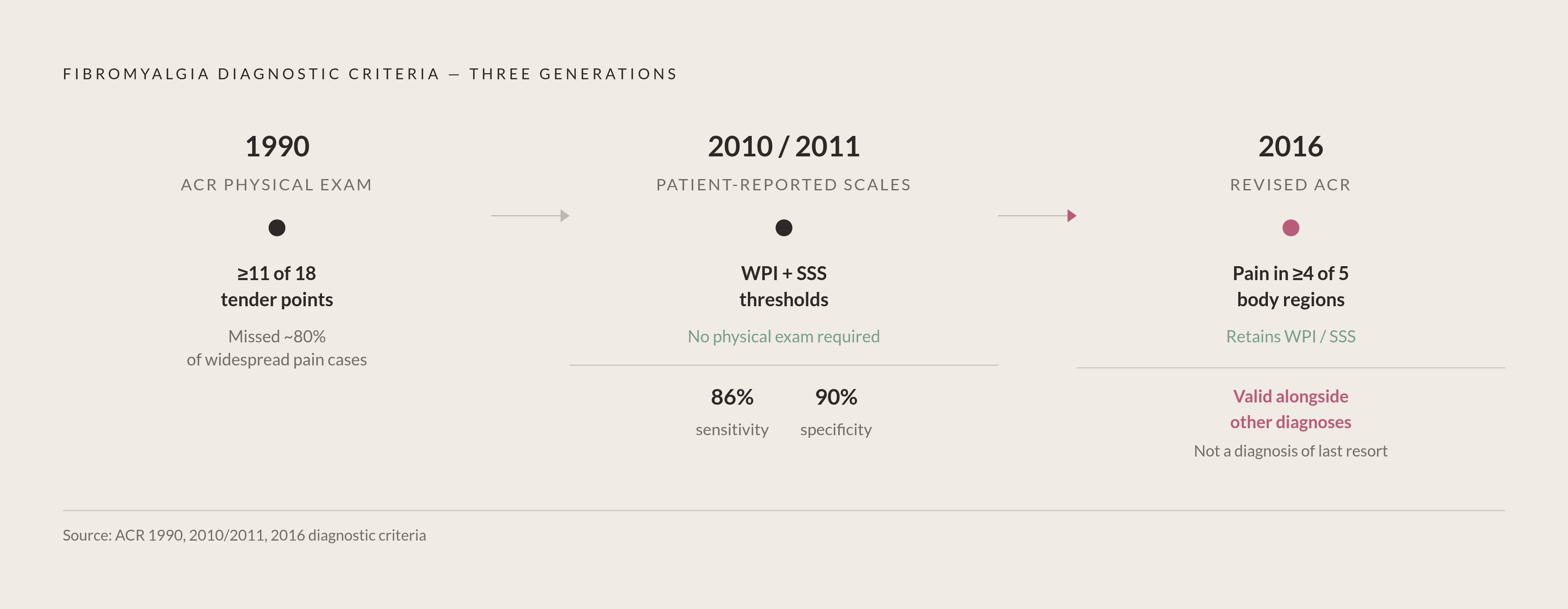
The 2010/2011 approach had one real weak spot: it could mistake a localized, regional pain syndrome for fibromyalgia, since nothing in the criteria explicitly required the pain to be generalized across the body. The 2016 revision, published in Seminars in Arthritis and Rheumatism that December, closed the gap by adding a generalized pain requirement.
Under the current, 2016-revised criteria, a diagnosis requires all four of the following:
- Generalized pain in at least 4 of 5 defined body regions
- Symptoms present at a similar level for at least 3 months
- WPI of 7 or higher with SSS of 5 or higher, or WPI of 4 to 6 with SSS of 9 or higher
- Recognition that fibromyalgia is valid as a diagnosis regardless of other conditions present
That fourth point deserves attention on its own, because it reverses decades of bad practice. Under the 1990 framework, doctors often felt obligated to rule out every other possible disease before landing on fibromyalgia, treating it as a diagnosis of last resort. The 2016 revision says that's not necessary: a fibromyalgia diagnosis does not require excluding other illnesses, and having another condition does not disqualify a patient from also having fibromyalgia. That single change is arguably the most consequential edit in the criteria's whole 35-year history, because it stops doctors from treating fibromyalgia as a diagnosis of exhaustion, something you land on only after every other test comes back clean.
Measured against the 1990 criteria and clinical judgment, the 2010/2011 approach showed a median sensitivity of 86% and specificity of 90%, numbers the revision's own authors called excellent agreement. The physician-administered 2016 criteria are considered valid for diagnosing individual patients; the self-report version stays useful for research only.
A separate framework, the AAPT criteria (ACTTION-APS Pain Taxonomy, joining the Analgesic, Anesthetic, and Addiction Clinical Trial Translations Innovations Opportunities and Networks group with the American Pain Society), exists as an alternative worth knowing about. Tender point exams haven't vanished either; they can still offer supporting clinical information, just not as a required gateway. Even so, there's still no gold-standard test, and some disagreement remains over which symptoms should count as essential.
Why the diagnostic delay remains so long despite better criteria
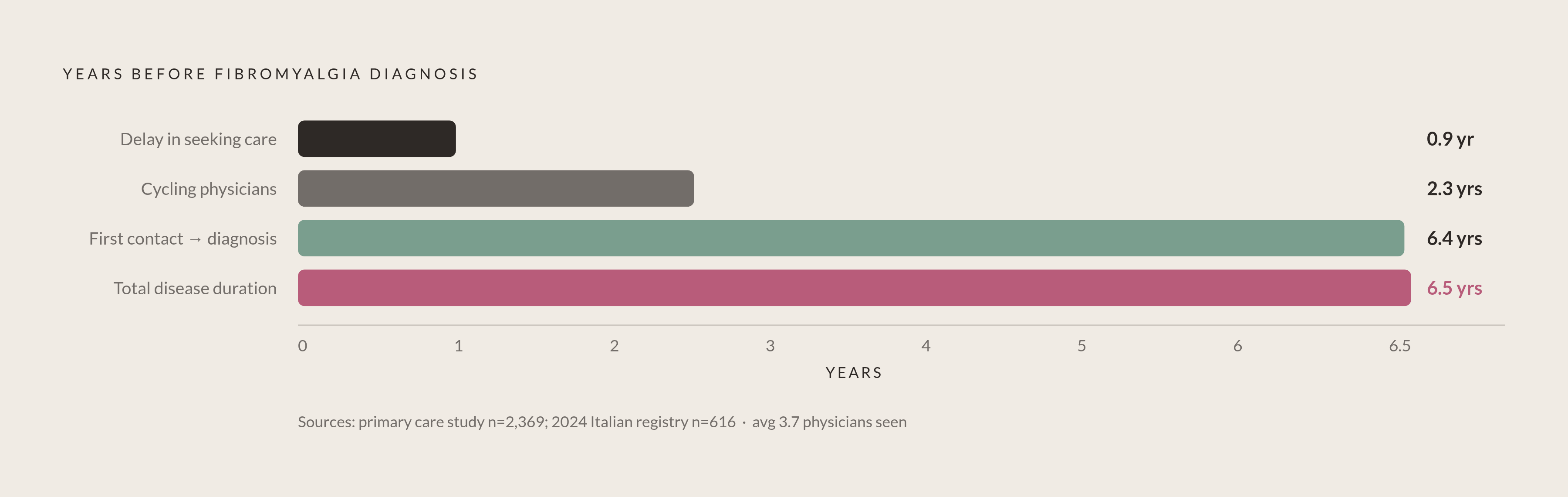
Better criteria haven't solved the speed problem, and pretending otherwise does patients no favors. A large primary care database study of 2,369 confirmed fibromyalgia patients found a mean time to diagnosis of 6.42 years. A 2024 Italian registry study of 616 fibromyalgia patients found the average time to diagnosis had dropped to 3.45 years, though mean disease duration by the time of diagnosis still ran to 6.46 years, meaning people were living with symptoms for years even after finally getting the label.
Research from Choy and colleagues painted a similarly rough picture: patients saw an average of 3.7 different physicians over 2.3 years before getting diagnosed, and waited an average of 11 months after symptoms started before even seeking medical help.
Blame the overlap first. Fibromyalgia's symptoms mimic hypothyroidism, rheumatoid arthritis, lupus, and multiple sclerosis closely enough that patients get run through that entire differential before anyone circles back to fibromyalgia. No objective test means clinicians lean on pattern recognition and informal rule-outs instead of a checklist they can run in one visit.
Stigma is the piece that shouldn't still be part of this story, but it is, and it needs to be named: some clinicians still treat fibromyalgia as a soft, psychological label instead of a recognized centralized pain condition with its own diagnostic architecture. That bias, not the absence of a lab test, costs patients years, marking the one part of this delay fixable without a single new study. Comorbidities, younger patient age, and older physician age are all linked to longer delays too.
The cost isn't abstract. Years spent undiagnosed or misdiagnosed usually mean years of the wrong treatments, worsening symptoms, and a patient's trust in the medical system wearing down bit by bit. Diagnosis speeds up considerably when clinicians know the current criteria cold and take a patient's own symptom report at face value instead of waiting for something to show up on a scan that was never going to show anything.
What the symptom picture looks like beyond pain, and why the full picture matters for diagnosis
Fatigue, unrefreshing sleep, and cognitive dysfunction aren't side effects of fibromyalgia anymore, they're written directly into the diagnostic criteria. That's a meaningful change from 1990, when none of it counted for anything.
Comorbidities complicate the picture further. Irritable bowel syndrome, migraine, TMJ disorders, depression, and POTS all show up frequently alongside fibromyalgia. None of them rule fibromyalgia out, but their presence can slow down recognition, since a doctor chasing a migraine diagnosis may not be thinking about widespread pain criteria at the same visit. The 2016 revision addresses this directly by stating that fibromyalgia can coexist with other clinically important illnesses. Comorbidity is the norm here, not some inconvenient exception.
Cognitive symptoms deserve more weight than they've historically gotten. Memory lapses, trouble concentrating, losing words mid-sentence: these can be as disabling as the physical pain, yet they got treated as an afterthought for years. Sleep works the same way. Non-restorative sleep isn't just a downstream consequence of being in pain, it's part of the core symptom structure and gets its own score on the Symptom Severity scale.
For patients, the full picture counts. Describing sleep quality, cognitive lapses, and fatigue patterns, not just where it hurts and how bad, is directly relevant to whether a doctor can check the boxes the current criteria require. Structured symptom tracking across these domains gives a clinician the actual data the 2016 criteria are built around, not just a pain score sitting on its own.
The psychological burden that sits alongside the physical symptoms
A 2024 systematic review and meta-analysis, drawing on 62 studies and 21,591 patients for anxiety and 88 studies covering 31,104 patients for depression, found that 46.6% of fibromyalgia patients experienced clinically significant anxiety, and 50.8% met criteria for depression. That's roughly half the fibromyalgia population carrying a diagnosable mood condition on top of chronic pain, which makes psychological screening at diagnosis a necessity, not an add-on.
Call it a double burden: physical pain and emotional suffering compounding each other, often without either one being fully acknowledged by the people around the patient. Maladaptive emotional patterns show up often too, more rumination, more catastrophizing, more self-blame, and less use of adaptive strategies like acceptance or positive reappraisal.
Research into psychological interventions for this population suggests they should prioritize reducing self-criticism and building self-reassurance, not just managing anxiety symptoms in isolation. A separate 2025 study found resilience correlated strongly with self-compassion (r = 0.663) and moved inversely with distress, with resilience acting as the mechanism connecting self-compassion to lower depression and anxiety.
There's an age pattern too: anxiety tends to ease as fibromyalgia patients get older, while depression tends to climb. None of this means psychiatric symptoms cause the pain. They're a consequence of living with pain that's chronic, often disbelieved, and rarely takes a day off, and once present, they turn around and intensify the physical burden right back.
Energy management, the boom-bust cycle, and why pacing is a medical strategy not a lifestyle preference
Christine Miserandino created Spoon Theory in 2003 to explain limited daily energy to people who'd never had to ration it themselves, using spoons as a stand-in for finite energy units spent across a day.
The boom-bust cycle wrecks patients who don't know to watch for it, and it runs on a predictable sequence. A good day tempts overexertion, which overloads a nervous system that's already running sensitized. Then, 24 to 48 hours later, post-exertional malaise sets in, forcing days or sometimes weeks of near-total inactivity to recover. Repeat that cycle enough and it doesn't stay neutral: nervous system inflammation and pain sensitivity both climb, good days get shorter, busts stretch longer. That's a progressive pattern, not a static one, which is exactly why "push through it" is the worst advice a fibromyalgia patient can follow.
Pacing is the answer, and it's a medical strategy, not a wellness suggestion, whatever the framing on a lifestyle blog might suggest. Formalized through frameworks like the Energy Envelope Theory, which lines up with Spoon Theory in prioritizing activity modification over pushing through limits, pacing means tracking daily activity and energy levels to spot patterns before they turn into a crash. It means planning demanding tasks around the energy actually available that day, and treating emotional stress as its own kind of energy expenditure rather than something separate from the physical.
Movement itself isn't the enemy here. Gentle activity, stretching, tai chi, a slow walk, can replenish energy rather than drain it, improving circulation and easing stiffness in a way that's fundamentally different from the exertion that triggers PEM. What this demands is a full break from rehabilitation-style thinking ("push a little harder each week") toward meticulous, ongoing energy management instead. Most mainstream health systems still aren't built to support that kind of care, and that gap is one patients end up closing themselves.
How patients can use the evolution of diagnostic criteria to advocate for themselves
The current criteria are patient-reported by design. The Widespread Pain Index and Symptom Severity scale both run on what the patient says, not what an exam finds, which means patients supply the actual evidence a diagnosis depends on. That role carries real responsibility, and treating it as optional leaves diagnostic power on the table.
Tracking symptoms across pain locations, fatigue levels, sleep quality, and cognitive lapses isn't just a self-care habit, it's the exact data structure the 2016 criteria are built to use. A patient who walks into an appointment able to say "here are the body regions where I've had pain for the past three months, and here's how my sleep and concentration have been affected" is handing a clinician something they can score directly against the WPI and SSS.
Knowing the criteria by name matters too. Telling a doctor "I've been tracking my widespread pain index regions" signals a level of familiarity that changes the conversation, shifting it from a patient hoping to be believed toward a patient and a clinician working from the same framework. Forty years of diagnostic evolution now bring less guesswork, less waiting to be taken seriously, and a shared language for a condition that spent decades without one.
Sources
- New guidelines for the diagnosis of fibromyalgia - ScienceDirect
- 2016 Revisions to the 2010/2011 fibromyalgia diagnostic criteria
- 2016 Revisions to the 2010/2011 fibromyalgia diagnostic criteria - ScienceDirect
- Reliability, Factor Structure and Predictive Validity of the Widespread Pain Index and Symptom Severity Scales of the 2010 American College of Rheumatology Criteria of Fibromyalgia
- Fibromyalgia: Diagnosis and Management
- (PDF) The American College of Rheumatology 1990 Criteria for the Classification of Fibromyalgia. Report of the Multicenter Criteria Committee
- clinexprheumatol.org
- pmc.ncbi.nlm.nih.gov