Why Most AI Health Assistants Fail Fibromyalgia Patients and What Built-for-Chronic-Illness Actually Means
AI health tools built for general patients miss what fibromyalgia patients actually need.
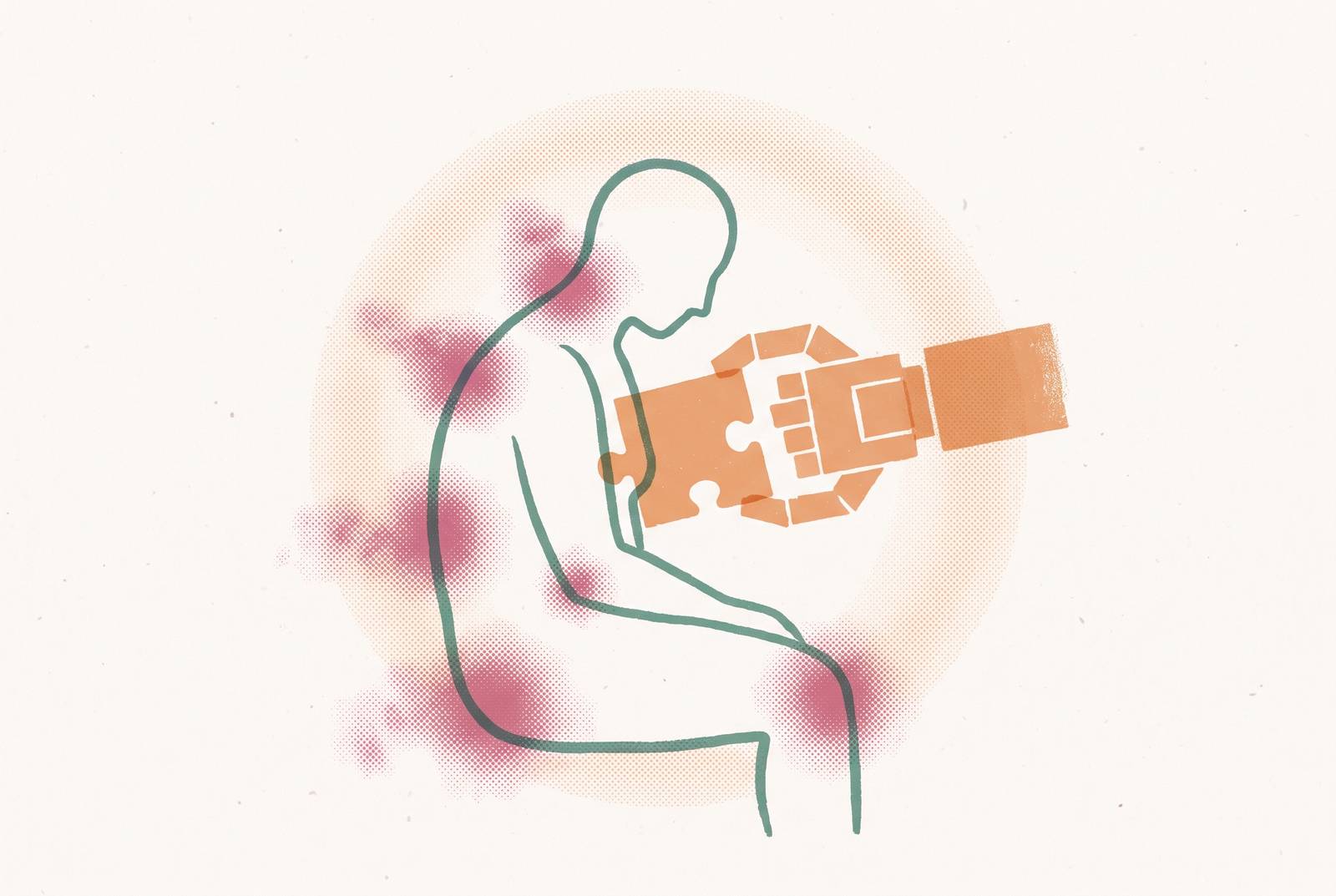
Most AI health assistants fail fibromyalgia patients because they lean on population averages while the condition varies sharply between people and within the same day. An AI health assistant for chronic illness patients needs to organize that variation, support energy management, and make patterns useful in clinical care. “Built for chronic illness” means designing around those needs.
Why fibromyalgia defeats population-average AI by design
Fibromyalgia involves widespread pain, fatigue, cognitive difficulties, and other symptoms that do not follow one standard pattern. Two people with the diagnosis can have very different experiences. The same person can also feel different from day to day and hour to hour, so what they said yesterday may not describe what they need today. There is no dependable “average patient” whose experience can stand in for everyone else.
Diagnosis reflects that complexity. The 2016 ACR criteria rely primarily on subjective symptom assessment and no longer require exclusion of other diagnoses. There is no objective biomarker for a general AI tool to anchor its assessment to. The patient’s account is therefore essential evidence. A tool that treats variation in those accounts as noise risks losing the information it needs most.
This creates a structural mismatch with population-average logic. Broad health patterns cannot, by themselves, explain how one person’s pain, sleep, fatigue, and daily function interact. The gender dimension makes that mismatch more consequential. Fibromyalgia disproportionately affects women, so a system calibrated on health data that historically underrepresented women’s chronic pain can compound an existing diagnostic injustice.
What the evidence shows about AI-generated fibromyalgia information
A peer-reviewed assessment of AI-generated fibromyalgia information found shortcomings in quality and actionability, with readability at university-level complexity. Several chatbots achieved moderate understandability, but that is not the same as giving patients information they can use. An answer can sound coherent and still leave the reader unsure what it means for their situation. Hard-to-read answers make it harder to get help when a person already has fatigue or cognitive difficulties.
A separate comparative analysis published in WORK: A Journal of Prevention, Assessment & Rehabilitation found significant variation in the complexity and readability of AI responses to fibromyalgia questions. Its authors urged extra care with diagnosis, treatment, and medication use and said healthcare professionals need to check the responses. The findings document weaknesses in the answers patients receive, though they do not establish that every AI tool fails in the same way.
Similar assessments of information for other chronic conditions have found inconsistent quality and complex language. That broader pattern suggests fibromyalgia is not an isolated edge case. However, evidence about generated health information is not a verdict on every possible use of AI. Sorting what patients say for a clearly set task differs from giving open-ended medical advice. AI can be useful with fibromyalgia data when its scope is clear and human oversight remains part of the work.
Why fibro fog, intra-day fluctuation, and subjective load break general AI workflows
Fibro fog can make it difficult to produce the clear, structured narrative a general AI assistant expects. A blank text box can be hard to use. It may demand careful recall, sequencing, and explanation at precisely the moment those tasks are hardest. If the workflow depends on a polished account, it places the burden of making the tool work on the person seeking support.
A once-daily check-in creates a different problem because symptoms can change within the day. One entry cannot distinguish a relatively manageable morning from a difficult afternoon unless it captures that change. Ecological Momentary Assessment records experiences as they occur in daily life, reducing the recall bias introduced by retrospective reporting. This helps with a known weakness in the usual ways of assessing fibromyalgia. Timing is part of the information.
The symptom load also exceeds what a single score can represent. Pain, fatigue, sleep disruption, mood, gastrointestinal symptoms, and headaches form patterns across dimensions and time. Recording one domain cannot reveal those relationships. Meanwhile, a survey at the Annual Thinking Lab on Fibromyalgia Syndrome (ATLAS 2024) found that most attending clinicians lacked sufficient AI knowledge and felt unprepared to integrate it into fibromyalgia management, despite extensive clinical experience and some prior AI exposure. Patients therefore cannot assume their clinician will be ready to help them evaluate a tool.
Why the physical-psychological split in AI health tools is especially harmful for fibromyalgia
A pain score leaves much of fibromyalgia’s burden unspoken. Anxiety, depression, isolation, and coping are part of the self-management picture. A study of what people with fibromyalgia said on social media found that most of their talk was about self-management and ways to cope. Their ties with physicians, medication side effects, their own fears, and their physical and mental health shaped what they talked about. The analysis also highlighted substantial noncompliance with therapeutic modalities, showing why recording symptoms alone cannot explain how care fits into daily life.
Research from the Universitat Oberta de Catalunya (UOC) found that AI could detect psychosocial signals, including anxiety and depression markers, within pain narratives that standard questionnaires missed. Integration is technically possible, but it requires deliberate design. Community research also found that patients valued clinicians who listened, validated their experience, and treated the whole person. An AI tool that ignores emotional content or reflexively hedges about a recognized condition can add to the burden of being disbelieved. Acknowledging that burden does not require the tool to diagnose anyone or make a clinical judgment.
A cross-sectional study of the purpose-built mental health AI Ash offers preliminary evidence about support for co-occurring physical and mental health needs. Active users with chronic conditions were more likely than non-users to report improved mental health, higher medication adherence, and fewer skipped chronic-condition care activities. Those findings establish associations. The study also did not directly compare the tool with general-purpose assistants. Its useful contribution is narrower, showing measurable differences when AI is designed for a defined health use case.
Energy management and post-exertional risk: the design requirement AI tools routinely ignore
Energy management is a safety requirement. Christine Miserandino’s spoon theory gives people with chronic illness a shared language for budgeting limited daily energy. Doing things costs spoons, and when people run out, they have to stop or borrow from the next day’s supply. For many patients, this is a way to describe the choices they make through an ordinary day. An assistant that urges a patient to do more without taking those limits into account may give advice that asks more than the patient can manage.
Delayed worsening makes a snapshot especially inadequate. The CDC describes post-exertional malaise in ME/CFS as worsening in the hours to days after effort, within a push-and-crash cycle. A morning report can therefore miss the later cost of overexertion. This guidance concerns ME/CFS specifically and should not be treated as evidence that every person with fibromyalgia has the same response. It is nevertheless a critical boundary for tools serving people with overlapping conditions or post-exertional symptoms.
Spoon counts also have limits as a measurement system. A 2025 study of pacing tools for long COVID found that some users felt the count did not match their actual state, and its researchers noted that more evidence was needed on how much pacing helps. The design response is to combine spoon-based tracking with contextual physiological and behavioural signals.
The 2021 NICE guideline NG206 makes energy management person-led in ME/CFS, covering cognitive, physical, emotional, and social activity. Activity is never automatically increased, though it may be adjusted upwards after a period of stability. The NHS lists energy management as a treatment for ME/CFS and states that graded exercise therapy is not recommended. When this guidance applies to a user, an AI tool must stay within those limits. Automatic activity escalation without patient-led verification is incompatible with that standard.
What multi-dimensional symptom tracking actually requires in a fibromyalgia context
Useful tracking needs to preserve the shape of the experience. Fibromyalgia pain is widespread and migratory, with different areas affected on different days. A body map can build a visual history of that distribution and movement, while a pain score alone cannot. The score may describe intensity, but it leaves location and migration out of the record.
The wider record needs sleep quality, activity levels, mood, medication timing and effects, and context such as stress, weather, and social activity. Tracking these things together lets people look at how they relate to each other over time. With separate logs, the patient has to piece the picture together. A tool built for fibromyalgia should help people see patterns in their entries and make clear that an apparent link does not prove that one thing caused another.
Patients can add details in their own words that fixed fields leave out. The UOC study found that AI could assess chronic pain severity from patient-written narratives with accuracy close to that of clinical experts, complementing standardized tools. However, it assessed single narratives rather than following successive accounts from the same patient over time. It does not establish that AI can reliably detect long-term changes. Longitudinal tracking remains a design requirement.
Access and output complete that design requirement. With voice and text options, patients can record what they experience without always having to type a structured log during fibro fog. Voice entry that is automatically organized can remove a real source of friction. Before an appointment, the tool should also summarize the period since the last visit, highlight medication changes, and flag new patterns and changes in function. Otherwise, the patient still has to turn a collection of entries into something a clinician can use.
What does an AI health assistant built for chronic illness actually do?
“Built for chronic illness” should describe observable choices. For a reader evaluating a tool, the test is whether it supports multiple symptom dimensions, entries within the day, pattern finding, pacing-based energy management, and clinician-ready output. These are not equivalent to a generic wellness conversation. A single-domain logger may suit recording one symptom, while a general chatbot may help explain information within clear limits. People who manage chronic conditions that affect each other day to day need more than either of these functions alone.
The development process should also be open to scrutiny. Patient-centered design means doing research with the people who will use the tool, including interviews with large numbers of people and co-design with chronic illness communities. Evidence of patient involvement helps distinguish a workflow built around fluctuating capacity from one that assumes users can always recall, type, and act consistently. Patients’ input should produce identifiable changes in the design.
The UOC researchers state that AI does not replace the specialist and must be used under clinical supervision. A companion and organizer should describe itself that way. The Ash findings give researchers an early benchmark for looking at outcomes, though they do not show that one tool is best or that purpose-built AI works better in every setting.
A tool that connects people living with the same conditions addresses isolation in a way tracking alone cannot. Community should therefore be part of the plan for the tool, even when its main job is to organize health information. The strongest evidence that an assistant understands chronic illness is a workflow that accommodates the person’s limits and helps them bring their experience into care without pretending to replace it.
Sources
- AI can help us understand chronic pain better
- (PDF) Assessment of the Artificial Intelligence– Generated Fibromyalgia Information: Beyond the Hype
- Healthcare Utilization, Chronic Condition Management, and Workplace Functioning Among Users of a Purpose-Built Mental Health AI (Ash): Cross-Sectional Study
- Cross-sectional Study on Medical Attitude Towards Artificial Intelligence Use in Fibromyalgia: Insights From the Annual Thinking Lab on Fibromyalgia Syndrome (ATLAS 2024)